How to Use a Peptide Calculator
A step-by-step guide to calculating peptide concentrations, reconstitution volumes, and working dilutions for research protocols — with worked examples for common research peptides.
Why Peptide Calculations Matter
Accurate concentration calculation is foundational to reproducible peptide research. A small error in reconstitution volume — using 2mL of BAC water instead of 1mL — halves your working concentration and invalidates any comparison with previous experiments or published literature using different volumes.
This guide covers everything needed to calculate reconstitution volumes, working concentrations, and per-dose volumes for any research peptide, with worked examples using peptides available from Peptide Warehouse Australia.
Need the answer now? Skip the manual maths and use our free Peptide Reconstitution Calculator. Enter vial size, BAC water volume, and target dose — it returns the exact insulin-syringe units to draw, plus the resulting concentration. Read on for the underlying maths.
The Core Equation
All peptide concentration calculations use one equation:
Concentration (mg/mL) = Amount of peptide (mg) ÷ Volume of diluent added (mL)
Or rearranged to find volume needed for a target concentration:
Volume needed (mL) = Amount of peptide (mg) ÷ Target concentration (mg/mL)
This is straightforward, but the units matter. Research protocols often specify doses in micrograms (mcg), so it's important to keep track of unit conversions:
- •1 mg = 1,000 mcg
- •1 mL = 1,000 μL (microlitres)
Step 1: Know What You're Starting With
Before calculating anything, identify:
- Peptide amount in the vial — e.g., 10mg, 50mg, 100mg
- Target concentration — what mg/mL you want to work with
- Diluent — always use pharmaceutical-grade bacteriostatic water (BAC water) for research peptides
A 10mg vial of BPC-157 contains 10 milligrams of lyophilised peptide. A 100mg vial of GHK-Cu contains 100mg. The numbers matter.
Step 2: Calculate Reconstitution Volume
Choose your target concentration, then calculate how much BAC water to add:
Volume (mL) = Peptide amount (mg) ÷ Target concentration (mg/mL)
Worked example 1: BPC-157 10mg
You want a working concentration of 5mg/mL:
Volume = 10mg ÷ 5mg/mL = 2mL BAC water
You want a working concentration of 10mg/mL:
Volume = 10mg ÷ 10mg/mL = 1mL BAC water
Worked example 2: GHK-Cu 100mg
You want a working concentration of 10mg/mL:
Volume = 100mg ÷ 10mg/mL = 10mL BAC water
You want a working concentration of 20mg/mL:
Volume = 100mg ÷ 20mg/mL = 5mL BAC water
Worked example 3: Retatrutide 10mg
You want a concentration of 2mg/mL for lower-concentration work:
Volume = 10mg ÷ 2mg/mL = 5mL BAC water
Step 3: The Full Reconstitution Reference Table
| Vial Size | BAC Water Added | Resulting Concentration |
|---|---|---|
| 10mg | 0.5mL | 20mg/mL (20,000 mcg/mL) |
| 10mg | 1mL | 10mg/mL (10,000 mcg/mL) |
| 10mg | 2mL | 5mg/mL (5,000 mcg/mL) |
| 10mg | 5mL | 2mg/mL (2,000 mcg/mL) |
| 10mg | 10mL | 1mg/mL (1,000 mcg/mL) |
| 50mg | 1mL | 50mg/mL |
| 50mg | 5mL | 10mg/mL |
| 50mg | 10mL | 5mg/mL |
| 100mg | 5mL | 20mg/mL |
| 100mg | 10mL | 10mg/mL |
Step 4: Calculate Volume Per Dose
Once your peptide is reconstituted at a known concentration, calculate the volume of reconstituted solution needed for a specific dose:
Volume (μL) = Dose (mcg) ÷ Concentration (mcg/μL)
Since 1mg/mL = 1mcg/μL (the units conveniently align):
Volume (μL) = Dose (mcg) ÷ Concentration (mg/mL)
Worked example: BPC-157 at 5mg/mL concentration
| Target Dose | Calculation | Volume to Use |
|---|---|---|
| 100 mcg | 100 ÷ 5,000 × 1000 | 20 μL (0.02mL) |
| 250 mcg | 250 ÷ 5,000 × 1000 | 50 μL (0.05mL) |
| 500 mcg | 500 ÷ 5,000 × 1000 | 100 μL (0.1mL) |
| 1,000 mcg (1mg) | 1000 ÷ 5,000 × 1000 | 200 μL (0.2mL) |
Worked example: GHK-Cu at 10mg/mL concentration
| Target Dose | Volume to Use |
|---|---|
| 500 mcg | 50 μL |
| 1mg | 100 μL |
| 2mg | 200 μL |
| 5mg | 500 μL |
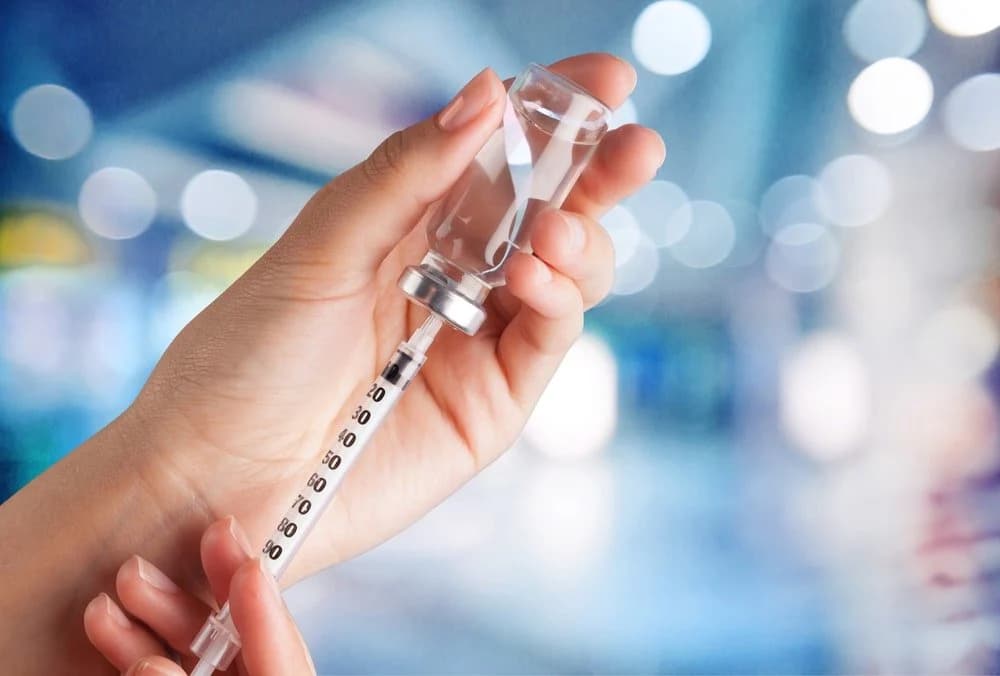
Step 5: Reading a Syringe for Small Volumes
Standard 31G insulin syringes are typically 0.5mL or 1mL capacity with 0.01mL (10μL) graduations. Reading small volumes:
- •0.1mL on an insulin syringe = 10 units on a U-100 syringe
- •0.05mL = 5 units
- •0.025mL = 2.5 units
For very small volumes (under 20μL), measurement accuracy improves significantly with smaller syringe barrel diameters. Standard 0.5mL insulin syringes are preferable to 1mL syringes for this reason.
When working with Semax 10mg or other peptides at low working concentrations, verify the syringe graduation interval carefully before drawing any volume.
Step 6: Dilution Calculations (Serial Dilutions)
Sometimes you need to prepare a lower concentration from a stock solution without reconstituting from powder again. Use the dilution equation:
C1 × V1 = C2 × V2
Where:
- •C1 = stock concentration
- •V1 = volume of stock to use
- •C2 = target (final) concentration
- •V2 = total final volume
Example: Diluting Retatrutide from 10mg/mL to 1mg/mL
You need 1mL total at 1mg/mL. Starting from 10mg/mL stock:
V1 = (C2 × V2) ÷ C1 = (1mg/mL × 1mL) ÷ 10mg/mL = 0.1mL stock + 0.9mL BAC water
Step 7: Calculating How Long a Vial Lasts
With your concentration and per-dose volume established:
Number of doses = Total volume in vial ÷ Volume per dose
Example: BPC-157 10mg reconstituted with 2mL BAC water at 5mg/mL
- •Total volume: 2mL = 2,000μL
- •Dose volume at 250mcg: 50μL
- •Number of doses: 2,000 ÷ 50 = 40 doses
Reconstituted peptides stored at 2–8°C are typically stable for up to 4 weeks. Plan your research to consume the reconstituted vial within this window. If 40 doses exceeds what you'll use in 4 weeks, consider reconstituting with a smaller volume so each vial can be used up within the stability window.
Common Peptide Calculator Reference: Our Products
| Product | Vial Size | Recommended Reconstitution | Resulting Concentration |
|---|---|---|---|
| [Retatrutide 10mg](/products/retatrutide-10mg) | 10mg | 1–2mL BAC water | 5–10mg/mL |
| [BPC-157 10mg](/products/bpc-157) | 10mg | 1–2mL BAC water | 5–10mg/mL |
| [GHK-Cu 100mg](/products/ghk-cu) | 100mg | 10mL BAC water | 10mg/mL |
| [Semax 10mg](/products/semax) | 10mg | 1–2mL BAC water | 5–10mg/mL |
| [Melanotan I 10mg](/products/melanotan-i) | 10mg | 1–2mL BAC water | 5–10mg/mL |
| [Melanotan II 10mg](/products/melanotan-ii) | 10mg | 1–2mL BAC water | 5–10mg/mL |
| [NAD+ 500mg](/products/nad-plus) | 100mg | 5–10mL BAC water | 10–20mg/mL |
| [BPC-157 + TB-500 Blend](/products/bpc-157-tb-500-blend) | 10mg (5+5) | 1–2mL BAC water | 5mg/mL each component |
Supplies Needed for Reconstitution
- •BAC Water 10mL — one 10mL vial covers multiple reconstitutions
- •Insulin Needles 31G — use one needle to draw BAC water, a separate needle to inject into the peptide vial (one per access)
- •Alcohol wipes and a clean work surface
- •Permanent marker for labelling vials with compound name, concentration, and date
See our step-by-step reconstitution guide for the full technique, including how to inject without disrupting the lyophilised cake.
Quick Reference Conversion Table
| Unit | Equivalent |
|---|---|
| 1mg | 1,000mcg |
| 1mL | 1,000μL |
| 1mg/mL | 1,000mcg/mL = 1mcg/μL |
| 0.1mL | 100μL |
| 0.01mL | 10μL |
Disclaimer: All calculations and information are provided for educational purposes related to in-vitro laboratory research. Not medical advice. Products are for research use only — not for human consumption, therapeutic use, or veterinary use.
Frequently Asked Questions
The core equation is straightforward: concentration in mg per mL equals the amount of peptide in milligrams divided by the volume of diluent added in millilitres. For example, adding 2mL of bacteriostatic water to a 10mg peptide vial produces a concentration of 5mg/mL (10 divided by 2). Rearranged to find the diluent volume needed for a target concentration: volume (mL) equals peptide amount (mg) divided by target concentration (mg/mL). The most common errors in this calculation come from unit confusion, particularly mixing milligrams and micrograms, or millilitres and microlitres. Always keep units consistent throughout the calculation chain.
Once your vial is reconstituted at a known concentration, the injection volume calculation uses the relationship that 1mg/mL equals 1mcg/microlitre — a convenient unit equivalence that simplifies the arithmetic. Volume in microlitres equals the desired dose in micrograms divided by the concentration in mg/mL. For example, with a vial reconstituted to 5mg/mL, a 250mcg dose requires 250 divided by 5 equals 50 microlitres. On a standard 31G insulin syringe, 50 microlitres corresponds to 0.05mL. Practising these calculations before handling the compound reduces errors during actual reconstitution and aliquoting.
The dilution equation C1 times V1 equals C2 times V2 is used when you need to prepare a lower working concentration from a stock solution without reconstituting from powder again. C1 is the stock concentration, V1 is the volume of stock to use, C2 is the target final concentration, and V2 is the total final volume. For example, to prepare 1mL at 1mg/mL from a 10mg/mL stock: V1 equals (C2 times V2) divided by C1, which equals (1 times 1) divided by 10 equals 0.1mL stock, diluted with 0.9mL bacteriostatic water. This is useful for concentration-response studies requiring multiple dilution points from a single reconstituted stock vial.
The number of doses from a 10mg vial depends entirely on the dose per session and the reconstitution concentration chosen. Using the formula: number of doses equals total peptide amount (mg) divided by dose per session (mg). For a 2mg dose, a 10mg vial yields 5 doses regardless of reconstitution volume (since reconstitution volume only affects concentration and injection volume, not total compound available). For a 0.5mg dose, the same vial yields 20 doses. Plan your reconstitution volume to ensure each dose can be measured accurately with your syringe — very small injection volumes (under 10 to 20 microlitres) increase measurement error relative to the dose.
The most important unit conversions in peptide research calculations are: 1 mg equals 1,000 mcg (micrograms); 1 mL equals 1,000 microlitres (microL); and 1mg/mL equals 1,000 mcg/mL, which also equals 1 mcg per microlitre. This last equivalence is particularly useful because it allows direct calculation of injection volumes in microlitres from doses in micrograms when concentration is expressed in mg/mL. On a standard U-100 insulin syringe, 0.1mL equals 10 units on the scale, 0.05mL equals 5 units, and 0.01mL equals 1 unit. Memorising these anchor conversions eliminates the most common calculation errors in peptide research protocols.
References
- 1.ICH Expert Working Group. “Q2(R1): Validation of Analytical Procedures — Text and Methodology.” International Council for Harmonisation of Technical Requirements for Pharmaceuticals for Human Use (2005). https://www.ich.org/page/quality-guidelines
- 2.Manning MC, Chou DK, Murphy BM, Payne RW, Katayama DS. “Stability of protein pharmaceuticals: an update.” Pharmaceutical Research (2010). https://pubmed.ncbi.nlm.nih.gov/20143256/
Related Articles
How to Reconstitute Peptides: A Step-by-Step Guide
Learn the correct technique for reconstituting lyophilised research peptides using bacteriostatic water for accurate, contamination-free preparations.
Research GuidesPeptide Storage Guide: How to Maximise Stability
Proper storage is critical to maintaining peptide integrity. Learn the correct temperature requirements and handling practices for lyophilised and reconstituted peptides.
Research GuidesGHK-Cu: Copper Peptide Research Guide
A detailed review of GHK-Cu (glycyl-L-histidyl-L-lysine copper complex) preclinical research, mechanisms, and protocols for tissue repair and skin biology research.
Research GuidesWhat Is Semax? A Guide to the Nootropic Peptide
A comprehensive review of Semax, the ACTH-derived synthetic heptapeptide studied for neuroprotective, neurotrophic, and cognitive effects in preclinical research.
Research GuidesWhat Is NAD+? Cellular Energy and Longevity
An in-depth review of NAD+ (nicotinamide adenine dinucleotide) research covering its role in cellular energy metabolism, DNA repair, sirtuin biology, and ageing research.
Research GuidesBuying Research Peptides in Australia: A Guide
Everything Australian researchers need to know when sourcing peptides: quality standards, COA verification, legal compliance, shipping, and what separates research-grade from low-quality suppliers.
Browse the full research blog or jump to the peptide catalogue.
Shop Bacteriostatic Water — Research Grade
GMP compliant · Independently tested · same-day dispatch on orders before 12PM AEST