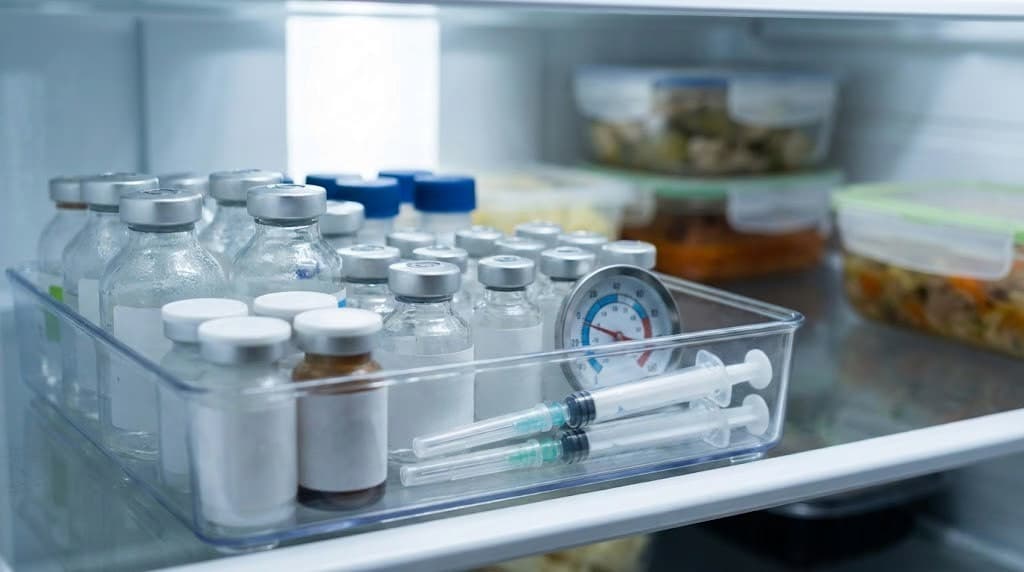
Peptide Storage Guide: How to Maximise Stability
Proper storage is critical to maintaining peptide integrity. Learn the correct temperature requirements and handling practices for lyophilised and reconstituted peptides.
Quick answer: Store unopened lyophilised peptide vials at -20°C — they remain stable for 12–24 months. After reconstitution with bacteriostatic water, store the solution at 2–8°C and use within 28 days. Keep all vials away from light, moisture, and repeated freeze-thaw cycles, which are the three biggest causes of degradation.
Why Storage Matters
Peptides are sensitive biomolecules. Incorrect storage — particularly exposure to heat, moisture, light, or repeated freeze-thaw cycles — can cause degradation, oxidation, aggregation, and loss of structural integrity, rendering them unsuitable for research. A 2010 review in *Pharmaceutical Research* (Manning et al.) identified temperature, pH, and moisture as the three primary variables governing protein and peptide pharmaceutical stability — all of which are controllable in a well-managed research laboratory. The lyophilised (freeze-dried) format used for research-grade peptides provides the best starting point for long-term stability, but proper storage conditions must be maintained from receipt through to the point of reconstitution to preserve the research integrity of the compound. Understanding the distinct stability profiles of lyophilised versus reconstituted peptides is the foundation of a reliable research storage protocol.
Lyophilised (Freeze-Dried) Peptides
Lyophilised peptides are the most stable form for long-term storage of research compounds. The freeze-drying process removes water to below 1% residual moisture, dramatically slowing the hydrolysis and oxidation reactions that cause degradation in aqueous solution. When stored correctly:
| Condition | Stability |
|---|---|
| −20°C (freezer) | 12–24 months |
| 2–8°C (refrigerator) | 3–6 months |
| Room temperature | Weeks to months (avoid if possible) |
Best practice: Store at −20°C until needed. Bring to room temperature before opening to prevent condensation from entering the vial.
Reconstituted Peptides
Once dissolved in bacteriostatic water, peptides are significantly less stable because the aqueous environment enables hydrolysis of peptide bonds, oxidation of susceptible amino acid residues (methionine, cysteine, tryptophan), and aggregation between unfolded peptide chains. The benzyl alcohol in bacteriostatic water prevents microbial growth but does not inhibit these chemical degradation pathways. As a general rule, reconstituted research peptides should be used within 4 weeks when refrigerated at 2–8°C. Stability timelines for reconstituted forms:
| Condition | Stability |
|---|---|
| 2–8°C (refrigerator) | Up to 4 weeks |
| −20°C (frozen) | Up to 3 months (avoid repeated freeze-thaw) |
| Room temperature | Hours to days only |
Key Storage Rules
- Avoid repeated freeze-thaw cycles — each cycle degrades the peptide. Use single-use aliquots if needed.
- Protect from light — UV can break peptide bonds. Store in amber vials or wrapped in foil.
- Keep dry — lyophilised peptides are hygroscopic (absorb moisture). Do not open vials in humid environments.
- Label everything — include compound name, batch number, concentration (if reconstituted), and date.
- Use desiccant — store multiple lyophilised vials in a container with desiccant packets.
Peptide-Specific Notes
- •GHK-Cu: The copper complex is relatively stable but protect from oxidation — store under inert atmosphere if long-term storage is required.
- •NAD+: Particularly sensitive to moisture and light. Store desiccated at −20°C.
- •Melanotan I/II: Protect from light exposure, which can cause photodegradation.
- •Retatrutide: As a larger peptide, follow strict cold-chain protocols from receipt.
Disclaimer: All information is for educational purposes related to in-vitro laboratory research. Not intended as medical advice.
Frequently Asked Questions
When stored at minus 20 degrees Celsius in a standard laboratory or household freezer, most lyophilised research peptides remain stable for 12 to 24 months from the date of manufacture. This assumes the vial has not been opened and that it is stored in a sealed, moisture-proof container with a desiccant pack to absorb any residual humidity. Some larger or more complex peptides may have shorter recommended storage windows, so always refer to the product-specific COA or storage instructions. A freezer with a stable temperature is preferable to one that undergoes frequent defrost cycles.
When a vial is taken from a cold environment (freezer or refrigerator) and opened immediately in a warmer, more humid laboratory environment, the temperature differential causes condensation to form on and inside the vial. Water vapour from the air can enter the vial and begin rehydrating the lyophilised powder before you intend it to, potentially causing localised degradation or clumping. Allowing the sealed vial to equilibrate to room temperature (15 to 20 minutes) before removing the cap prevents this condensation effect and preserves the integrity of the lyophilised powder.
Repeated freeze-thaw cycles are one of the primary causes of reconstituted peptide degradation. Each cycle stresses the molecular structure through ice crystal formation and mechanical shear during freezing, and through brief exposure to sub-optimal temperatures during thawing. For most research peptides, no more than two to three freeze-thaw cycles are recommended before significant degradation risk becomes a concern. The practical solution is to aliquot the reconstituted solution into single-use volumes immediately after reconstitution, so each aliquot is only frozen and thawed once.
Yes, a standard household refrigerator set to 2 to 8 degrees Celsius is appropriate for storing reconstituted peptide solutions for up to 4 weeks. However, household refrigerators are less stable in temperature than laboratory models and may have zones that fluctuate more widely, particularly near the door. Store peptide vials in the main body of the refrigerator, away from the door. For lyophilised stock, a freezer at minus 20 degrees Celsius is strongly preferred. Avoid refrigerators with automatic defrost cycles that frequently cycle above 0 degrees Celsius.
NAD+ is especially sensitive to moisture and light, both of which accelerate its degradation. As a dinucleotide rather than a peptide, its N-glycosidic bond between nicotinamide and ribose is susceptible to hydrolysis even in trace moisture, producing nicotinamide and ADP-ribose as breakdown products. Light exposure can promote oxidation of the nicotinamide ring. Best practice for NAD+ is storage at minus 20 degrees Celsius in an amber vial or opaque container with a desiccant pack, and preparation of stock solutions in low-light conditions using neutral pH diluent.
References
- 1.Manning MC, Chou DK, Murphy BM, Payne RW, Katayama DS. “Stability of protein pharmaceuticals: an update.” Pharmaceutical Research (2010). https://pubmed.ncbi.nlm.nih.gov/20143256/
- 2.Wang W. “Lyophilization and development of solid protein pharmaceuticals.” International Journal of Pharmaceutics (2000). https://pubmed.ncbi.nlm.nih.gov/10985315/
- 3.Pikal MJ. “Freeze-drying of proteins: process, formulation, and stability.” ACS Symposium Series (1994). https://pubs.acs.org/doi/10.1021/bk-1994-0567.ch004
Related Articles
How to Reconstitute Peptides: A Step-by-Step Guide
Learn the correct technique for reconstituting lyophilised research peptides using bacteriostatic water for accurate, contamination-free preparations.
Research GuidesHow to Use a Peptide Calculator
A step-by-step guide to calculating peptide concentrations, reconstitution volumes, and working dilutions for research protocols — with worked examples for common research peptides.
Research GuidesGHK-Cu: Copper Peptide Research Guide
A detailed review of GHK-Cu (glycyl-L-histidyl-L-lysine copper complex) preclinical research, mechanisms, and protocols for tissue repair and skin biology research.
Research GuidesWhat Is Semax? A Guide to the Nootropic Peptide
A comprehensive review of Semax, the ACTH-derived synthetic heptapeptide studied for neuroprotective, neurotrophic, and cognitive effects in preclinical research.
Research GuidesWhat Is NAD+? Cellular Energy and Longevity
An in-depth review of NAD+ (nicotinamide adenine dinucleotide) research covering its role in cellular energy metabolism, DNA repair, sirtuin biology, and ageing research.
Research GuidesBuying Research Peptides in Australia: A Guide
Everything Australian researchers need to know when sourcing peptides: quality standards, COA verification, legal compliance, shipping, and what separates research-grade from low-quality suppliers.
Browse the full research blog or jump to the peptide catalogue.
Shop Bacteriostatic Water — Research Grade
GMP compliant · Independently tested · same-day dispatch on orders before 12PM AEST