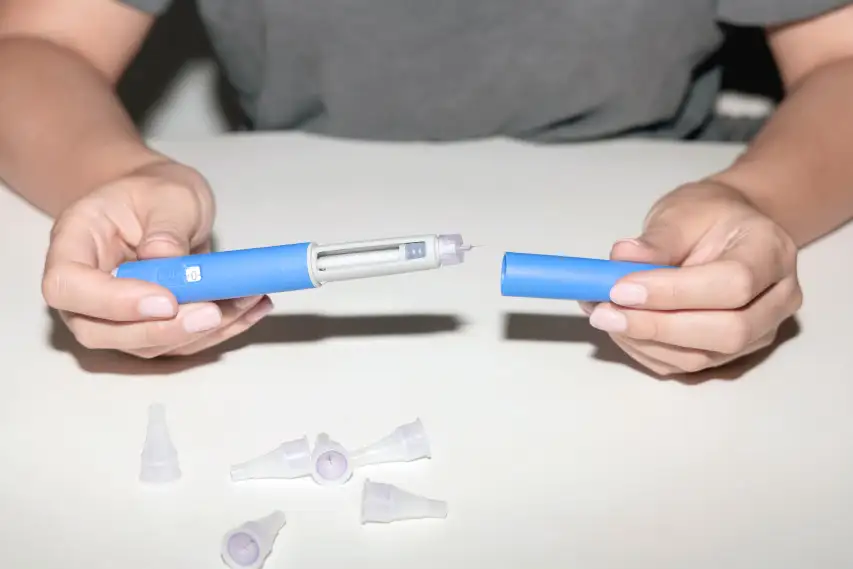
Why Are Research Peptides Sold as Vials, Not Pens?
Research peptides come as lyophilised powder in vials, not pre-filled pens like clinical GLP-1 medications. Here's the science and regulatory reasoning behind why — and what it means for your research setup.
The Question Researchers Ask
If you've come across GLP-1 medications in the news, you'll know they're delivered via pre-filled injection pens — devices that click, measure a dose, and inject at the press of a button. So why do research peptides like Retatrutide, BPC-157, and GHK-Cu come as white powder in small glass vials instead?
The answer involves pharmaceutical chemistry, regulatory frameworks, stability science, and the nature of research use itself.
1. Stability: Lyophilised Powder vs Liquid Solution
The most fundamental reason is chemistry. Peptides in liquid solution are unstable. Water is not a benign carrier — it's an active participant in degradation reactions:
Hydrolysis
Peptide bonds are susceptible to hydrolysis (water-mediated cleavage). In aqueous solution at physiological pH and temperature, peptides slowly break down into shorter fragments. This process accelerates with:
- •Higher temperature
- •Acidic or alkaline pH
- •Metal ion contamination
- •Freeze-thaw cycling of liquid formulations
Oxidation
Certain amino acid residues (methionine, cysteine, tryptophan, histidine) are susceptible to oxidative degradation. In solution, dissolved oxygen promotes this process.
Aggregation
At higher concentrations, peptide molecules can associate and form aggregates — reducing the active monomer concentration and potentially altering the compound's research properties.
The lyophilisation solution
Lyophilisation (freeze-drying) removes water from the peptide while it is frozen, via sublimation under vacuum. The result is a dry, glassy powder that:
- •Has dramatically reduced hydrolysis rate (no free water)
- •Is stable at −20°C for 12–24 months — far longer than any liquid formulation
- •Can be stored at room temperature for shorter periods (weeks to months) without significant degradation
- •Resists oxidation better than aqueous solutions
Pharmaceutical-grade peptide pens use proprietary stabilised liquid formulations with extensive pharmaceutical development behind them — pH adjustment, buffer selection, preservative optimisation, and anti-aggregation excipients. This formulation work is a multi-year, multi-million dollar process. Research peptide suppliers don't have equivalent formulation infrastructure, nor is it necessary for the research use case.
The lyophilised vial is not a limitation — it's the optimal format for research-grade peptide stability.
2. Regulatory Framework: Research Use vs Therapeutic Use
Pre-filled injection pens are a finished pharmaceutical product — a medical device containing a pharmaceutical drug at a defined therapeutic dose, ready for patient self-administration. Producing them requires:
- •TGA registration (in Australia) or equivalent regulatory approval in other jurisdictions
- •GMP-compliant manufacturing for pharmaceutical products (which differs from research-grade GMP)
- •Clinical trials demonstrating safety and efficacy for the specific indication
- •Pharmacovigilance programs for post-market safety monitoring
- •Dose confirmation testing for the pen device itself
Research peptides are sold for in-vitro laboratory research, not for human therapeutic use. This is a fundamentally different regulatory category. Suppliers do not have — and are not seeking — TGA approval to supply finished pharmaceutical products. Selling research peptides as pre-filled pens would imply therapeutic intent and would constitute supplying an unregistered therapeutic good under the Therapeutic Goods Act 1989.
The vial format, combined with requiring the researcher to reconstitute and prepare the compound themselves, is consistent with research chemical supply. It is not a format designed for patient self-administration.
For more on the legal framework, see our guide: Are Research Peptides Legal to Buy in Australia?
3. Dose Flexibility for Research Protocols
Clinical pens are engineered for fixed therapeutic doses — approved GLP-1 pens dispense 0.25mg, 0.5mg, 1mg doses. This makes sense for a medication where the clinical dose has been established by phase III trials.
Research, by definition, involves exploring dose-response relationships. A researcher studying Semax or GHK-Cu in a cell model may need:
- •Multiple concentration points (e.g., 1nM, 10nM, 100nM, 1μM)
- •Different volumes for different assay formats (96-well plate vs flask)
- •Specific molar concentrations based on receptor binding constants from published literature
Reconstituting a lyophilised vial lets the researcher prepare exactly the stock concentration needed for their specific protocol. A fixed-dose pen offers no flexibility — you get one concentration and one volume.
This is also why understanding how to use a peptide calculator is essential for anyone setting up research protocols. The vial format requires the researcher to calculate their own working concentrations, but this is a feature, not a bug — it gives complete control over experimental variables.
4. Cold Chain and Transport
Peptide pens are designed for patient use — which means they need to be stable at refrigerator temperature (2–8°C) continuously, and often have requirements for maximum room-temperature exposure time.
Lyophilised vials can be:
- •Stored at −20°C for 12–24 months (long-term)
- •Transported at ambient temperature briefly without degradation (the powder is dry and stable)
- •Stored at 2–8°C for months once received
This makes the lyophilised vial format significantly more robust for the research supply chain. When Peptide Warehouse Australia ships Retatrutide 10mg from our Australian warehouse, it arrives as a stable powder that you can store in your −20°C freezer for months before it's needed.
A liquid pen formulation shipped without continuous cold chain would begin degrading immediately.
5. Purity Verification and Batch Testing
Research-grade peptides require third-party purity verification by HPLC before release. This is batch testing on the powder — measuring the purity of the lyophilised compound.
Pre-filled pens are complex multi-component systems (drug + device + excipients) that would require different and more extensive quality testing to verify dose accuracy, device reliability, and formulation stability over the product shelf life. This is pharmaceutical product testing, not research compound testing.
Our Certificate of Analysis process for lyophilised peptides is described in our HPLC purity guide — every batch gets HPLC purity, mass spectrometry identity confirmation, and sterility screening. This approach is appropriate for research-grade supply.
6. What This Means for Your Research Setup
The vial format requires a small amount of preparation. For complete research setups, you need:
| Item | Purpose |
|---|---|
| Lyophilised peptide vial | Your research compound |
| [BAC Water 10mL](/products/bac-water-10ml) | Diluent for reconstitution |
| [31G insulin needles](/products/insulin-needles-31g) | Drawing and injecting |
| Alcohol wipes | Aseptic technique |
| Refrigerator (2–8°C) | Post-reconstitution storage |
This is a complete research setup. The Retatrutide Research Bundle includes the peptide, BAC water, and needles together — everything needed in one order.
Common Questions About the Vial Format
"Can't I just buy a pre-filled solution instead of lyophilised powder?"
Some suppliers offer aqueous peptide solutions, but these are significantly less stable than lyophilised powder. Without pharmaceutical-grade stabilising excipients, a peptide in solution at room temperature will degrade within days to weeks. Lyophilised powder is the correct format for research-grade peptide supply.
"Is reconstitution difficult?"
No — the process takes under 5 minutes and requires no specialist equipment. See our complete reconstitution guide for step-by-step instructions.
"Why can't I buy research peptides in pen form for convenience?"
As covered above, a pre-filled pen is a finished pharmaceutical product implying therapeutic use intent — which is not the legal or regulatory framework under which research peptides are sold. The vial format is not arbitrary; it is consistent with research use and optimal for compound stability.
Summary
Research peptides come as lyophilised vials because:
- Stability — dry powder is far more stable than any liquid formulation without pharmaceutical excipients
- Regulatory — pen devices imply finished pharmaceutical products requiring TGA registration
- Research flexibility — vials allow researchers to prepare any concentration for any protocol
- Cold chain — powder tolerates brief ambient temperature exposure during shipping
- Quality testing — batch HPLC testing is performed on the powder, not on a finished device
The lyophilised vial is the gold standard format for research-grade peptides. All products at Peptide Warehouse Australia are supplied in this format, independently tested, with full COA documentation.
Disclaimer: All information is for educational purposes related to in-vitro laboratory research. Not for human consumption, therapeutic use, or veterinary use. Research peptides are not medications and are not approved by the TGA for any therapeutic indication.
Frequently Asked Questions
Lyophilisation (freeze-drying) removes water from the peptide compound by sublimation under vacuum while the material is frozen, leaving a dry glassy powder. Water is not a benign carrier for peptides — it actively participates in degradation reactions including hydrolysis (cleavage of peptide bonds by water molecules), oxidation of susceptible residues such as methionine and cysteine, and facilitation of aggregation at higher concentrations. Removing water from the equation dramatically slows all of these processes. Lyophilised peptides stored at minus 20 degrees Celsius can remain stable for 12 to 24 months, whereas liquid peptide solutions without pharmaceutical-grade stabilising excipients may degrade significantly within days to weeks at the same temperature.
A pre-filled injection pen is a finished pharmaceutical product — a medical device containing a drug at a defined therapeutic dose, intended for patient self-administration. Producing and supplying this requires TGA registration in Australia as a therapeutic good, completion of clinical trials demonstrating safety and efficacy for a specific indication, GMP manufacturing for pharmaceutical products (which differs from research-grade GMP), and a post-market pharmacovigilance programme. Research peptide suppliers operate under a completely different regulatory framework — they supply research chemicals for in-vitro laboratory use, not registered therapeutic goods. Supplying research peptides in pen format would constitute supplying an unregistered therapeutic good and imply therapeutic intent.
GMP certification for research peptide synthesis (typically ICH Q7 for active pharmaceutical ingredients) focuses on consistent synthesis processes, raw material quality, equipment qualification, batch records, and quality testing. Pharmaceutical product GMP (for finished dosage forms including pen devices) additionally requires validated drug product manufacturing processes, stability testing of the formulated product, sterility assurance for the entire fill-finish process, device-specific testing (dose accuracy, injection force), and labelling compliance for the specific approved indication. The latter is substantially more extensive and costly. Research peptide suppliers are certified at the API synthesis level, not at the finished product manufacturing level that would be required for pen devices.
Researchers occasionally ask about pre-filled solutions because they are familiar with clinical GLP-1 pen devices from media coverage and perceive the reconstitution step as an extra complication. In practice, reconstituting a lyophilised vial takes under 5 minutes and requires only bacteriostatic water, a syringe, and an alcohol swab. The perception that solution format is more convenient is outweighed by the significant stability disadvantages: a peptide solution without pharmaceutical excipients degrades much faster than the lyophilised powder, particularly at room temperature. Any solution format offered by research suppliers without proper stabilising excipients would have inferior stability, not improved convenience.
Clinical pen devices are engineered for specific therapeutic doses established by Phase 3 clinical trials — for example, approved GLP-1 pens dispense fixed increments of 0.25mg, 0.5mg, or 1mg. Research protocols, by contrast, require exploring dose-response relationships across a range of concentrations to characterise the pharmacological effect of a compound in the specific model system being studied. A lyophilised vial lets the researcher choose exactly the reconstitution volume and therefore exactly the working concentration needed for their protocol — whether that is nanomolar concentrations for cell culture work or milligram-per-millilitre stocks for in-vivo rodent studies. This complete flexibility over concentration is a feature of the vial format, not a limitation.
References
- 1.Wang W. “Lyophilization and development of solid protein pharmaceuticals.” International Journal of Pharmaceutics (2000). https://pubmed.ncbi.nlm.nih.gov/10985315/
- 2.Pikal MJ. “Mechanisms of protein stabilization during freeze-drying storage: the relative importance of thermodynamic stabilization and glassy state relaxation dynamics.” Drugs and the Pharmaceutical Sciences (1994). https://pubs.acs.org/doi/10.1021/bk-1994-0567.ch004
- 3.Manning MC, Chou DK, Murphy BM, Payne RW, Katayama DS. “Stability of protein pharmaceuticals: an update.” Pharmaceutical Research (2010). https://pubmed.ncbi.nlm.nih.gov/20143256/
Related Articles
How to Reconstitute Peptides: A Step-by-Step Guide
Learn the correct technique for reconstituting lyophilised research peptides using bacteriostatic water for accurate, contamination-free preparations.
Research GuidesPeptide Storage Guide: How to Maximise Stability
Proper storage is critical to maintaining peptide integrity. Learn the correct temperature requirements and handling practices for lyophilised and reconstituted peptides.
Research GuidesHow to Use a Peptide Calculator
A step-by-step guide to calculating peptide concentrations, reconstitution volumes, and working dilutions for research protocols — with worked examples for common research peptides.
Research GuidesGHK-Cu: Copper Peptide Research Guide
A detailed review of GHK-Cu (glycyl-L-histidyl-L-lysine copper complex) preclinical research, mechanisms, and protocols for tissue repair and skin biology research.
Research GuidesWhat Is Semax? A Guide to the Nootropic Peptide
A comprehensive review of Semax, the ACTH-derived synthetic heptapeptide studied for neuroprotective, neurotrophic, and cognitive effects in preclinical research.
Research GuidesWhat Is NAD+? Cellular Energy and Longevity
An in-depth review of NAD+ (nicotinamide adenine dinucleotide) research covering its role in cellular energy metabolism, DNA repair, sirtuin biology, and ageing research.
Browse the full research blog or jump to the peptide catalogue.
Shop Research-Grade Peptides
GMP compliant · Independently tested · same-day dispatch on orders before 12PM AEST